Many people of all ages attend me due to their eczema. It impacts on them not just because of its redness, dryness and itch but also a source of stress and pain while impacting on their life decisions, personal relationships, education and work.
For parents of children with eczema, it can be quite upsetting to see your child uncomfortable, not sleeping and avoiding activities due to their skin condition.
During your consultation, I will want to hear your story. We will devise a treatment regime specific to your needs and lifestyle to help empower you manage and take control of your eczema

You should start applying steroid cream if your skin is red due to eczema. There is only need to apply steroid to the red areas. The type of steroid cream your doctor will prescribe you will depend on the severity or degree of redness of your eczema or on the location of your eczema.
One “Finger Tip Unit” of steroid cream can safely cover two palms worth of the adult palm.
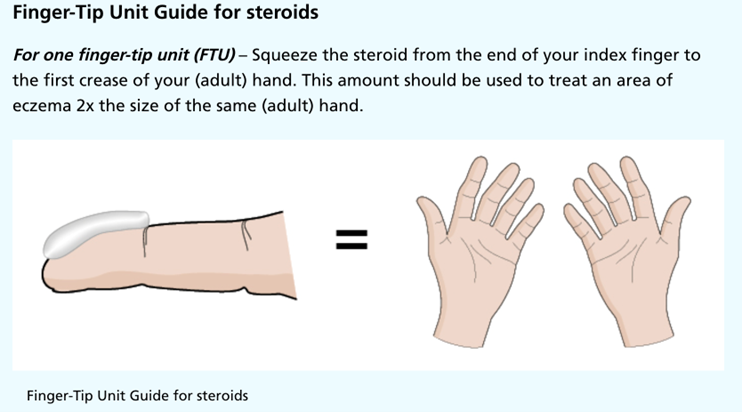 Image : Courtesy of Leeds Teaching Hospitals
Oftentimes, the infants, children and adults I see require two topical steroid regiemes, one for their acute flare ups and another to maintain their skin clear.
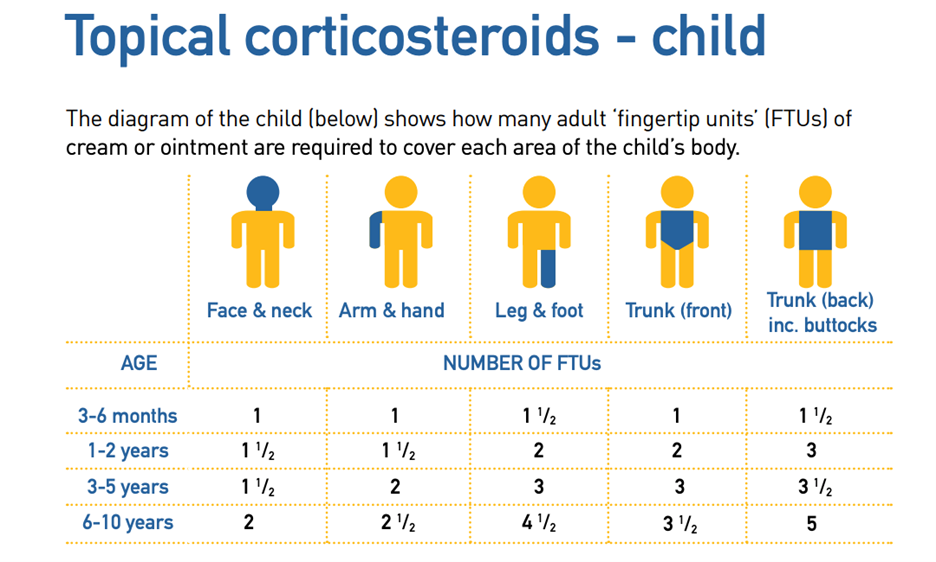 Image : Courtesy of the Irish Skin Foundation Eczema Information Leaflet
"There is no right or wrong moisturiser to use. The most important thing is that you like using the moisturiser you have chosen."
One of the best times to apply an emolient is straight after a bath or a shower. AFter a bath or a shower, just pat the skin dry just so the skin is slightly damp and when you put your emolient on , it will trap in some of that moisture.
Soap substitutes can make the bath or the shower slippery so we do advise that they use a bath or a shower mat.
The emollient should be applied liberally and quickly in a downward direction of the hair so that you don't trap the cream into the hair follicle which can cause sore bumps called folliculitis. I say to patients “think of how you would rub a dog, you don't go over and back, you go in one direction only.
Avoid putting your hand into a tub of moisturiser as it will contaminate the tub and increase risk of skin infection. So we recommend that pts use a spatula or a spoon to remove moisturiser. Don’t put the left over moisturiser back into the tub as this will undo your good work.
Timing of steroid application: I advise patients that the most important thing is that 30 minutes is left between applying the steroid and the emolient to avoid dilution of the steroid. Peoples lives are quite busy, so I have advise that one of the products can be applied in the morning while the other
Here are is some useful content, well worth a watch or listen.

![[background image] retail setting with neatly arranged products (for a pharmacy)](https://cdn.prod.website-files.com/69811ccf6cce30577ab21480/699f3a39697b78fde0b4e760_ffc321450c9ea7d10b4b048b41724fdc_6981ffabb5c6e037fab282ac_52d4b7864628e4f206f7e72dbbeebf93_maxresdefault.png)